
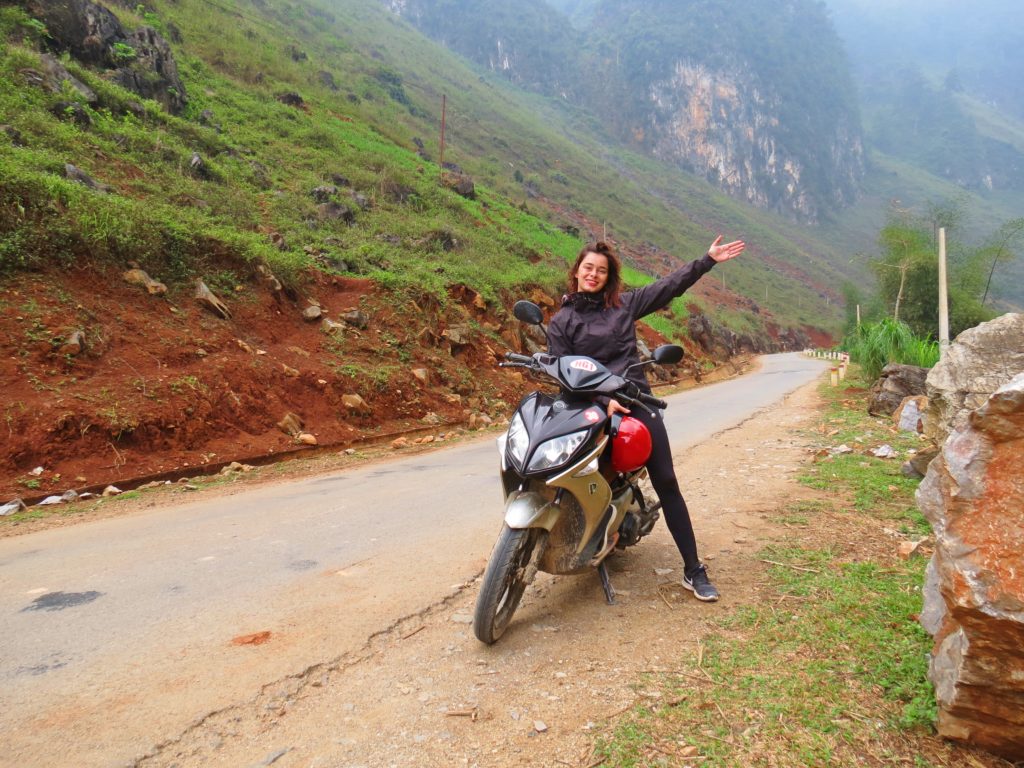
The Ha Giang Extreme Motorbike Loop 3 days itinerary at the end of my Southeast Asia trip was one of the best things I have ever done during my travels.
It was challenging, exciting, and an experience I know will stay with me for a lifetime.
The Ha Giang Extreme Motorbike Loop is often called Vietnam’s ultimate off-the-beaten-path adventure — and for good reason.

| Editor’s Note: This post was originally published in November 2017 and has been updated for freshness, accuracy, and comprehensiveness in October 2024. |
Located in Vietnam’s northernmost province along the Chinese border, Ha Giang offers a raw, untouched landscape of towering limestone mountains, deep valleys, winding rivers, and hidden ethnic villages.
Unlike the more famous Sapa, Ha Giang remains relatively undiscovered and authentic, often described as the most beautiful region in Northern Vietnam.
So, if you’re planning your Vietnam itinerary and are looking for something truly off the beaten path, the Ha Giang Extreme Motorbike Loop should absolutely be on your list.
Of course, visiting the world-famous Ha Long Bay and taking one of the popular Ha Long Bay cruises is another must-do experience in Vietnam. However, during my trip, I decided to skip Ha Long Bay in favor of its less crowded and much cheaper alternative — Cat Ba Island — but that’s a different story.


Now, let’s dive into everything you need to know about planning your own Ha Giang Extreme Motorbike Loop 3-day itinerary!
| One of the most recommended companies for doing a Ha Giang Loop tour is Valor. They stand out particularly because they make sure their groups stay very small. This allows for a much more personalized experience and access to secret areas. The guides also speak perfect English, which is rare in this region of Vietnam. Contact Tom on WhatsApp for more information: +84 33 947 0571. |
Table of Contents
Where is Ha Giang and Why Is it So Special?
Ha Giang is a province in the Northeast region of Vietnam and contains the country’s northernmost point. It shares a 270 km border with Yunnan province in Southern China, making it Vietnam’s final frontier.
Ha Giang’s population is around 700,000 people, and it’s still growing.
Interestingly, about 90% of the population belongs to various ethnic minority groups, each with its own unique culture, traditions, and way of life.
Unfortunately, Ha Giang is also one of the least developed regions in Vietnam.
That said, tourism is slowly but surely increasing.
While foreign travelers are starting to discover the magic of Ha Giang, many Vietnamese from other parts of the country have already begun exploring the region and riding the famous loop.
One of the main reasons Ha Giang remained isolated and undeveloped for so long was the political tension with China.
Thankfully, those times are now behind, and with government support, new roads have been constructed and infrastructure has improved dramatically, making it much easier for both locals and travelers to access the region.
I have to mention that while I was doing the Ha Giang Extreme Motorbike Loop, there were still many roadworks and repairs happening in different places along the way.
The loop is definitely getting more accessible, but it’s still rough around the edges, which, in many ways, is part of its charm.

About the Ha Giang Extreme Motorbike Loop
The Ha Giang Extreme Motorbike Loop is one of the most adventurous things you can do in Vietnam. It’s already popular among Vietnamese travelers, and its reputation is slowly growing among international visitors too.
The loop can technically be done in 2 days if you rush through it, but I wouldn’t recommend that. If you have more time, you can easily stretch it to 5 days or even a week, with plenty of stunning stops along the way.
I personally completed the Ha Giang Extreme Motorbike Loop on a 3-day itinerary, and it worked perfectly.
If I had had more time, I would have loved to include a visit to Cao Bang and the breathtaking Ban Gioc Waterfall on the Chinese border.
Food, accommodation, and ATMs are available along the route. (more info below)
In total, my Ha Giang Extreme Motorbike Loop 3 days itinerary covered over 400 kilometers, with around 20 hours of driving.
*Another recommendation: If you’re not up for a motorbike adventure, you can still tour Ha Giang without a motorbike.
Or if you don’t want to do the loop by yourself, as I did, you can join an organized Ha Giang Loop Tour. Check the one below run by Vietnam Cheers Hostel, including kayaking on the Nho Que River:


Ha Giang Extreme Motorbike Loop 3-Day Itinerary Breakdown
Day 1: Ha Giang to Dong Van
I started my Ha Giang Extreme Motorbike Loop 3 days itinerary early in the morning, knowing I had a full day of riding ahead.
The plan was simple: reach Dong Van by evening, with plenty of time for stops along the way.
The day began with heavy rain, forcing me to delay my start.
I tried heading out once, but quickly turned back as the downpour made riding impossible.
A few hours later, the rain finally eased, and I decided to go for it, despite the drizzle and thick fog that stayed with me most of the way.

The road from Ha Giang to Dong Van is generally in good condition, but the rain made it slippery, and the endless curves, combined with the typical chaotic Vietnamese driving, kept me alert the entire time.
I stopped for lunch in Yen Minh, a small town about halfway through the day’s ride.
It took me nearly four hours to get there, even though it’s less than 100 km from Ha Giang — a reminder that distances on the loop mean little compared to the actual time it takes to drive.

After a simple meal and some hot ginger tea, I continued to Dong Van, reaching the town just before sunset. Without a booking, I found a cozy hostel with hot showers, good Wi-Fi, and — best of all — an empty dorm all to myself.
Dinner was a random pick at a family-run restaurant where I couldn’t communicate with the locals in English so I simply pointed at someone else’s dish to order the same, and then I called it a night, ready for whatever the next day would bring.
Day 1 stats:
- 🛵 155 km
- 🕓 About 7 hours of driving

Day 2: Dong Van to Lung Cu & Lung Cu to Meo Vac
After a good night’s sleep, I was excited for the second day of my Ha Giang Extreme Motorbike Loop 3-day itinerary.
The plan: visit the Lung Cu Flag Tower, the northernmost point of Vietnam, and then continue through the stunning Ma Pi Leng Pass to Meo Vac for the night.
I spent the morning wandering around Dong Van, soaking in the slow rhythm of local life.
By late morning, I got back on the motorbike and headed to Lung Cu, about 38 km away.
The ride took nearly two hours due to terrible road conditions — mud, rocks, potholes, and ongoing construction. How I made it without falling, I still wonder.
At Lung Cu, I bought a ticket (25,000 VND) and climbed the stairs to the flagpole.
The views were absolutely worth it — endless fields, scattered villages, and the Chinese mountains in the distance.

After enjoying the scenery, I rode back through Dong Van and continued toward Meo Vac, along the legendary Ma Pi Leng Pass.
Known as the “King of Vietnamese mountain passes,” Ma Pi Leng rises to 1,500 meters and offers jaw-dropping views at every turn.
I couldn’t resist stopping every few meters for photos, especially at the main viewpoint overlooking the river and dam.

After soaking in the beauty, I rode the final stretch to Meo Vac.
I stayed at a guesthouse recommended by a fellow traveler I had met earlier in Phnom Penh — a huge room with two king-size beds and a private bathroom, all to myself once again.
I spent the afternoon strolling through town, sipping what turned out to be the best coffee I’ve ever had, and catching a beautiful sunset — the perfect end to the day.
Day 2 stats:
- 🛵 94 km
- 🕓 About 4 to 4.5 hours of driving

Day 3: Meo Vac to Ha Giang
My final day on the Ha Giang Extreme Motorbike Loop 3 days itinerary started, fittingly, with another cup of that amazing coffee.
The weather was beautiful, and although I was excited for the day’s ride, I couldn’t help feeling a little sad that the journey was coming to an end.
If I had had more time, I would have extended the loop to five or six days, adding a visit to Cao Bang Province and the Ban Gioc Waterfall – so if you can allow yourself more time for this adventure, consider adding those places to your itinerary, please.
I made a few stops along the way to soak in the scenery and snap some last photos before reaching Ha Giang in the early afternoon.

Once back, I grabbed lunch, returned my motorbike, and booked a bus ticket to Hanoi for that same evening.
The rest of the afternoon was spent simply waiting and reflecting on the incredible journey I had just completed.
Without a doubt, riding the Ha Giang Extreme Motorbike Loop was one of the best and most memorable experiences of my travels, a true highlight of my first trip to Southeast Asia.
If you’re visiting Vietnam and want something unforgettable, I can’t recommend this adventure enough.
Ha Giang Extreme Motorbike Loop FAQ
How to get to Ha Giang?
There are two main ways to get to Ha Giang, the starting point of the loop: by bus or by motorbike, if you already have one.
Since I didn’t have my own bike, I took a bus from Cat Ba, another great off-the-beaten-path destination in Vietnam.
The journey took many hours and was definitely not the most pleasant experience. It was a typical Vietnamese sleeping bus — the “beds” were too short, people around were snoring loudly or watching videos without headphones, and I personally can’t fall asleep on buses anyway, so it felt like one of the longest rides of my life.
So, if you also don’t have a motorbike, you’ll likely need to take one of these sleeping buses as well.
There are direct bus connections from both Cat Ba and Hanoi to Ha Giang.
I paid 500,000 VND for the trip from Cat Ba to Ha Giang, which included a bus to the port, a ferry ride, a scooter transfer to the bus station, and then the actual sleeping bus to Ha Giang. The return trip from Ha Giang to Hanoi cost me 200,000 VND, with a travel time of around nine hours.
Keep in mind that these prices aren’t fixed.
I booked my tickets through the hostels I was staying at, but I also compared prices beforehand. It’s a good idea to check with several hotels, hostels, and travel agencies because prices can vary a lot.

Accommodation on the Ha Giang Loop
Before starting my Ha Giang Extreme Motorbike Loop, I didn’t book any accommodation in advance. Instead, I had a few recommendations and simply went straight to the places once I arrived, and it worked out just fine.
Of course, whether or not to book ahead is completely up to you.
If you feel more comfortable having everything arranged, go ahead and reserve your stays in advance.
Here’s where I stayed and what I paid:
-
In Ha Giang, I stayed at 10 AM Hostel.
Lovely staff, breakfast included, and you can leave your luggage there for free while you do the loop.
I paid 68,000 VND per night. -
In Dong Van, I stayed at Dong Van B&B (surprisingly, no breakfast included!).
Once you’re in town, you’ll find it listed as Dong Van Resort.
The dormitory was great, the owner was hilarious, and the price was 100,000 VND per night. -
In Meo Vac, I stayed at Mr. Hung’s Guesthouse.
I paid 125,000 VND for a private room, which was spacious and very comfortable.
It seems that the llop adventure is becoming more and more popular, so showing up without a reservation might not be such a great option nowadays. I also did the loop in March, which is typically a low season in Northern Vietnam, so that could have helped as well.

My room in Meo Vac
Renting a motorbike for the Ha Giang Loop
There are plenty of places to rent a motorbike in Ha Giang, and most offer similar prices. The main question is whether you want an automatic or a semi-automatic bike.
Semi-automatic bikes are cheaper, costing around 150,000–170,000 VND per day.
Since I don’t know how to drive a semi-automatic, I needed an automatic, which usually costs around 200,000 VND per day.
However, I found a better deal at Ha Giang 1 Hostel, where I rented an automatic bike for 160,000 VND per day. The savings almost covered the cost of fuel for my three-day trip.
If you’re renting a semi-automatic (and prices are generally the same everywhere), it’s easiest to just book through the place you’re staying at.
When renting, no one will ask you for a driver’s license, you rent at your own risk. However, technically, you do need a valid motorbike license or an International Driving Permit if you get stopped by the police. Many travelers ride without one, but be aware that fines are possible if you’re unlucky.
*Since October 31, 2018, it has been mandatory for all foreign riders in Ha Giang to hold either a valid Vietnamese motorbike license or an International Driving Permit (IDP) with the correct motorbike endorsement if you want to drive legally.
You’ll usually need to leave a deposit, and if any damage occurs, you’ll be responsible for paying for the repairs.

Getting a Permit in Ha Giang
Separate from the IDP, you also need a permit to travel through the Ha Giang Province border area, close to China. This is a different permit and applies to everyone traveling through certain districts like Dong Van and Meo Vac, regardless of whether you are riding a motorbike or not.
The process to get this permit is very easy.
You simply walk into the immigration office, and everyone knows why you are there.
You will need to hand over your original passport, the staff will fill out the paperwork for you, and after paying the fee of 230,000 VND, you will receive your permit and be ready to start the loop.
Many hotels and hostels can also arrange the permit for you, but they usually charge a small service fee, but since the process is very quick and simple, it is just as easy to go and do it yourself.
Where to get your permit from?
You can get your permit from the Ha Giang Immigration Office:
- Address: 296 Tran Phu Street, Ha Giang.
Make sure to go in the morning or early afternoon, as the office is closed for lunch between 11:30 am and 1:30 pm.
Do you really need the permit?
While some travelers report never being asked to show it, some guesthouses may require it for check-in. There is also the chance you could get pulled over by the police, and if you are asked for the permit and do not have it, you could face fines or other trouble. It is much safer and easier to have it with you.

How much does the Ha Giang Extreme Motorbike Loop cost?
Last but not least — how much does it actually cost to do the Ha Giang Extreme Motorbike Loop?
I’ve already mentioned some prices throughout this post, but here’s the full breakdown:
Motorbike rental:
- 160,000 VND per day = around €6 / $6.80 / £5.20
- 480,000 VND for 3 days = around €18 / $20.40 / £15.60
Gas:
- My total spend on gas was about 160,000 VND for 3 days = around €6 / $6.80 / £5.20
Accommodation:
- Two nights (one in Dong Van and one in Meo Vac) = 100,000 + 125,000 VND = 225,000 VND
- Around €8.50 / $9.60 / £7.30 in total
Permit:
- 230,000 VND = around €8 / $9.80 / £7.50
Lung Cu Flag Tower entrance fee:
- 25,000 VND = around €0.90 / $1.05 / £0.80
Food and water:
- My total spend was around 300,000 VND for 3 days = around €11 / $12.80 / £9.50
In total, I spent approximately 1,420,000 VND for the full trip, which is around €53 / $61 / £46.
I’d say that’s very affordable for such an unforgettable adventure and one of the best travel experiences you can have in Vietnam.
* Please note that these were my personal expenses. You can spend more or less depending on your travel style, where you stay, what you eat, and any extra activities you choose to do.
Also, keep in mind that while these prices are mostly still accurate as of 2024, small changes are always possible.

I hope this (almost 3,000-word) guide helps you plan your Ha Giang Extreme Motorbike Loop 3-day itinerary and gives you a better idea of what to expect. If you have any additional questions or if you need more tips or information, feel free to contact me – I’ll be happy to help!
Enjoy the ride!
Thanks for reading,
Bilyana
If you like this post, please share it with your friends and follow Owl Over The World on Facebook, Instagram, and TikTok for more travel tips & inspiration.
Disclosure: Please note that some of the links in this post are affiliate links, which means I will receive a small commission if you make a booking after clicking. It comes at no extra cost to you but it helps me with the running of this site! As always, opinions are my own. Thank you!

